

If you hear the word leadership and immediately think of student council badges, debating trophies, or corporate titles, you are already looking too late.
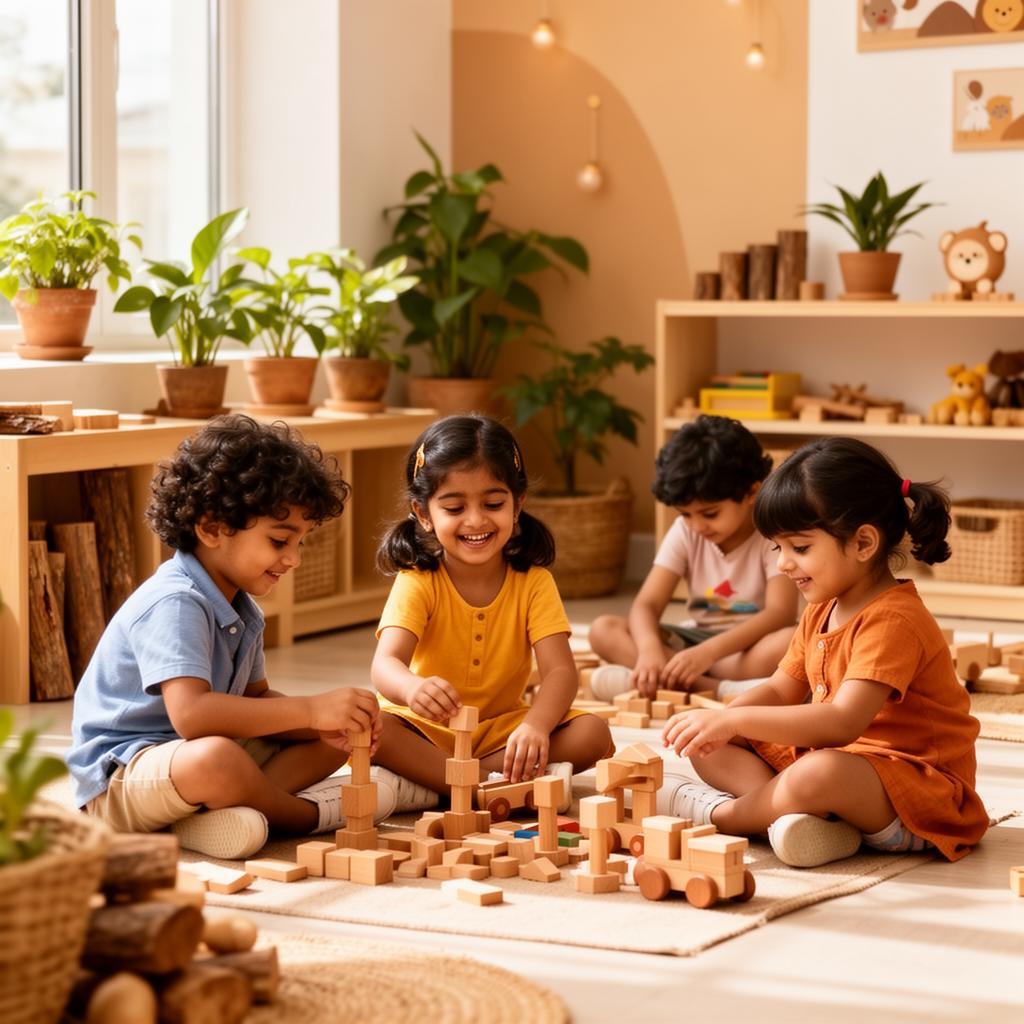
Leadership does not begin when a child is old enough to give a speech. It begins much earlier — when a three-year-old learns to wait for a turn, repair after hurting a friend, persist through frustration, or gather two other children into a shared game.
That may not look like leadership in the adult sense. It looks small. Domestic. Ordinary. But that is precisely the point. Leadership in early childhood is not performance. It is pattern.
Before a child can lead others, they have to begin managing themselves. Before they can influence a group, they have to learn how to enter one. Before they can stand up for what is right, they have to experience what it feels like to act with courage, empathy, and responsibility in the tiny social worlds that make up everyday childhood.
This is why the real question is not whether leadership should be taught in the early years. It is whether we understand what leadership actually is.
First, let’s remove the wrong picture
When adults talk about leadership for children, we often smuggle in the wrong image: the confident extrovert, the child who speaks first, the one who takes charge of a room.
That is too narrow — and in the early years, often misleading.
A preschool child showing the foundations of leadership may be the one who:
- notices another child crying and goes to comfort them;
- remembers the rules of a game and helps the group hold them;
- suggests a new idea when the block tower keeps collapsing;
- resists the urge to grab, even when they badly want the toy;
- says, “Let’s do it together,” instead of trying to win alone.
That is not “baby management training.” It is the beginning of self-regulation, agency, collaboration, and ethical choice.
In ISL’s language, that is already the early form of leadership.
What research says is happening in these years
A 2025 study in Cognitive Development examined how leadership characteristics appear in young children and what shapes them. Drawing on reports from preschool teachers and parents, the study found that early leadership traits are not random personality quirks. They are strongly shaped by the behaviour of adults, the quality of peer interaction, and the richness of the learning environment (Cognitive Development, 2025).
That matters because it shifts the conversation. Leadership is not something we suddenly “switch on” in adolescence. It is something children rehearse, repeatedly, in relationship with adults, peers, and environments.
A second body of work helps explain how this happens. The Center on the Developing Child at Harvard describes executive function and self-regulation as the brain’s “air traffic control system” — the set of capacities that help us manage information, focus attention, resist impulses, and plan ahead (Harvard Center on the Developing Child).
These capacities are deeply relevant to leadership.
Because what is leadership, in practice?
- Holding a goal in mind
- Managing your impulses under stress
- Adapting when the situation changes
- Coordinating with other people
- Making a choice and staying with it
That is executive function in real life.
The early years do not finish the job. But they are one of the most formative windows for building these muscles. So when a child learns to pause, listen, negotiate, persist, and repair, we should not dismiss it as merely “good behaviour.” We should recognize it as foundational human capability.
Why early childhood matters more than we admit
Many schools and parents still treat the early years as a soft prelude to “real learning.” As long as children are cheerful, reciting a rhyme, and bringing home a craft sheet, we assume things are broadly fine.
But the truth is more demanding.
By the age of three or four, children are already building habits around:
- how they respond to frustration,
- whether their voice matters,
- whether conflict can be resolved without fear,
- whether rules are arbitrary or meaningful,
- whether other people are competitors, collaborators, or both.
These are not side issues. These are the foundations of how a child will later show up in classrooms, teams, friendships, and eventually workplaces and society.
By thirteen, we often try to retrofit what should have been cultivated much earlier. We tell teenagers to be resilient after years of overprotection or overcontrol. We ask them to communicate confidently after years of being interrupted, rushed, or compared. We want leadership without first building ownership, self-command, and social trust.
That is backwards.
If leadership is treated as a late-stage extracurricular — one more line on a résumé — we will keep producing children who know how to perform confidence without necessarily possessing judgment, steadiness, or character.
The home matters too: warmth and boundaries are not opposites
Schools are only one part of the picture. Parents shape the emotional climate in which early leadership either grows or shrinks.
A Bengaluru-based study published in the International Journal of Contemporary Pediatrics examined parenting styles and the social-emotional development of preschool children. The study found a significant relationship between parenting style and children’s social-emotional development, and it reinforces a widely observed truth: children do best when adults combine warmth with clear expectations (Sukumaran & Balakrishna, 2021).
That combination matters.
Children do not become strong by living in either chaos or fear. They grow when they experience both safety and structure.
At home, that can look like:
- listening without surrendering all boundaries;
- explaining the “why” behind rules;
- offering limited, real choices;
- helping a child name a feeling without letting the feeling run the household;
- expecting repair after harm, instead of only demanding obedience.
This is one of the great confusions of modern parenting and schooling alike: people imagine that warmth makes children soft, and structure makes them strong. In reality, children need both.
Warmth without boundaries can produce drift.
Boundaries without warmth can produce compliance without inner strength.
Leadership needs something better: a child who feels secure enough to act, and guided enough to act well.
What “leadership-building” actually looks like in a preschool classroom
If we take all of this seriously, then leadership in early childhood should not mean cheesy “leader of the day” rituals or teaching three-year-olds to behave like miniature CEOs.
It should mean building the conditions in which leadership naturally develops.
A strong early-years classroom does at least five things well.
1. It gives children meaningful responsibility
Not fake responsibility. Real responsibility scaled to age.
A child can help set up snack time, welcome a new classmate, carry materials carefully, help clean up, or remind the group of what was decided. These moments teach that participation matters.
2. It treats conflict as curriculum
When children grab, exclude, interrupt, or dominate, the goal is not only to stop the behaviour. The goal is to teach the child how to understand impact, repair trust, and try again differently.
That is moral formation, not just classroom management.
3. It builds voice without building arrogance
Children should be invited to ask questions, make suggestions, explain their thinking, and disagree respectfully. Leadership is not loudness. It is the confidence that one’s voice can enter a shared space without crushing others.
4. It normalises challenge without humiliation
Good early-years classrooms do not confuse rigor with pressure. They allow struggle, but not shame. Children are stretched through rich play, open-ended questions, role play, teamwork, and repeated attempts — not through fear, comparison, or premature academic display.
5. It makes collaboration visible
Many children are praised for finishing quickly or getting the answer right. Fewer are praised for helping a group think better, including another child, or staying with a shared task when it becomes difficult. But those are precisely the habits that matter later in life.
This is why “leadership begins at 3” is not a slogan. It is a design principle.
Why this matters especially in India
In India, many parents face a false choice in the early years.
On one side is the school that looks “serious” because it pushes children too early into worksheets, performance, and comparison.
On the other side is the school that looks “happy” but feels vague — warm in mood, perhaps, but unclear in purpose.
What thoughtful parents actually want is harder to find: rigor without fear, warmth without looseness, identity without ideology, and confidence without entitlement.
That is where leadership as a lens becomes powerful.
If we understand leadership correctly, we stop asking whether preschool is “too early” for it. Instead, we begin asking better questions:
- Is my child learning to handle frustration?
- Are they learning to include others?
- Do they experience structure without intimidation?
- Are they given opportunities to take responsibility?
- Are adults around them modelling calm, fairness, and self-command?
Those questions will tell you far more about a school than whether a four-year-old has already memorised something impressive.
Bringing it back to your child
So what does this mean for a parent of a three- or four-year-old?
It means leadership is already showing up — quietly — in ordinary moments.
When your child waits, persists, apologises, helps, includes, speaks up, calms down, or starts again, they are not just becoming “school-ready.” They are learning how to live with other human beings in a way that is responsible, confident, and constructive.
That is where leadership begins.
Not on a stage. Not with a badge. Not at thirteen.
It begins in the nervous system, in relationships, in repeated choices, and in the small moral dramas of everyday childhood.
The schools that understand this will not merely prepare children to perform well later. They will help shape the kind of people children become.
And in a world that has no shortage of successful people but a deep shortage of grounded, courageous, and collaborative ones, that may be the most important kind of education we can offer.