
Leadership Is a Practice, Not a Position
At ISL, a leader is not the loudest person in the room or the one who finishes first. Leadership, here, means something more specific - the depth to do things well, the grounding to do them right, and the imagination to see what others haven't yet.
These are not situations knowledge alone can navigate. A strong academic foundation builds clarity, discipline and reasoning. But what determines action is deeper: judgement, values, and the ability to think beyond instruction.
Built through how children learn, what they are trusted with, and what they are responsible for, at ISL leadership is practiced, everyday.
Every child will need to lead – their own choices, and often, the responsibility of others

How learning is designed
Development is not one-dimensional. Both contemporary research and Indian frameworks such as the Panchakoshas recognise this. At ISL, this shapes how learning is structured.
Children learn to think and act through multiple lenses, drawing from global frameworks and Indian systems of thought. Indian intellectual systems of thought play a defining role. They shape how students read context, weigh consequence, and take responsibility.
From the early years, development is shaped across capability, character and creativity, together. The practice of leadership surfaces across the school experience, everyday.
The Curriculum
The Cambridge IGCSE provides the academic rigour.
Students do not move forward by completing content. They work through it by using it.
Concepts are applied, explained, and revisited through repeated use.

The Day
Time is structured deliberately.
Beyond academics, time is protected for building, discussion, and reflection.
Students test ideas early, improve over time, and present evolving thinking.
The Measure
Progress is not reduced to marks.
Each child is understood across multiple intelligences through their work, collaboration, and response to real situations.
Growth is tracked over time, showing not just outcomes, but how a child works.

The Environment
Learning is shaped by more than the classroom.
Teachers, peers, mentors, and daily structure shape what a child attempts and how their work is challenged. Over time, this shapes how they think, respond, and grow.

What it looks like in practice
A child is not only asked to learn. At ISL,they are asked to use what they learn.
Case Methodology
Students work through real scenarios and dilemmas.They step into situations, make decisions, and solve problems—before being told what is correct.

Each Kid a Teacher
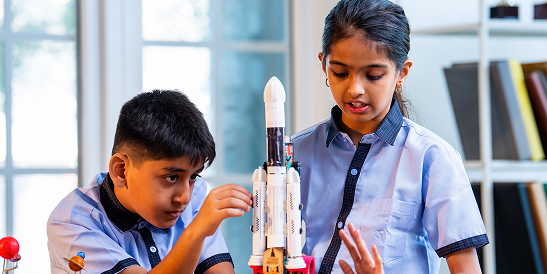
Understanding is built through articulation. Students explain, teach, and present until ideas become clear and usable.
Mentor Club
Students engage with people in the real world. They see how decisions are made and carried through.

How we understand each child
Leadership is not captured in a single result. It is seen in how a child thinks, works, and responds over time. At ISL, this is understood continuously across the school experience through the Intelligence Wheel.
Each axis represents a dimension of growth. Together, they show how a child is developing across thinking, behaviour, and action. This view evolves over time, making progress and change visible across facets of their actions, decisions and choices.

Profile 1

Profile 2

Profile 3
Explore how leadership is built
Not through instruction, but through how children learn, work, and take responsibility – every day.